6.9.10

Weird or just plain crazy?

The Bible tells us that God created Adam and Eve just a few thousand years ago, by some fundamentalist interpretations. Science informs us that this is mere fiction and that man is a few million years old, and that civilization just tens of thousands of years old. Could it be, however, that conventional science is just as mistaken as the Bible stories? There is a great deal of archeological evidence that the history of life on earth might be far different than what current geological and anthropological texts tell us. Consider these astonishing finds:

The Grooved Spheres
Over the last few decades, miners in South Africa have been digging up mysterious metal spheres. Origin unknown, these spheres measure approximately an inch or so in diameter, and some are etched with three parallel grooves running around the equator. Two types of spheres have been found: one is composed of a solid bluish metal with flecks of white; the other is hollowed out and filled with a spongy white substance. The kicker is that the rock in which they where found is Precambrian - and dated to 2.8 billion years old! Who made them and for what purpose is unknown.

The Dropa Stones
In 1938, an archeological expedition led by Dr. Chi Pu Tei into the Baian-Kara-Ula mountains of China made an astonishing discovery in some caves that had apparently been occupied by some ancient culture. Buried in the dust of ages on the cave floor were hundreds of stone disks. Measuring about nine inches in diameter, each had a circle cut into the center and was etched with a spiral groove, making it look for all the world like some ancient phonograph record some 10,000 to 12,000 years old. The spiral groove, it turns out, is actually composed of tiny hieroglyphics that tell the incredible story of spaceships from some distant world that crash-landed in the mountains. The ships were piloted by people who called themselves the Dropa, and the remains of whose descendents, possibly, were found in the cave.


The Ica Stones
Beginning in the 1930s, the father of Dr. Javier Cabrera, Cultural Anthropologist for Ica, Peru, discovered many hundreds of ceremonial burial stones in the tombs of the ancient Incas. Dr. Cabrera, carrying on his father's work, has collected more than 1,100 of these andesite stones, which are estimated to be between 500 and 1,500 years old and have become known collectively as the Ica Stones. The stones bear etchings, many of which are sexually graphic (which was common to the culture), some picture idols and others depict such practices as open-heart surgery and brain transplants. The most astonishing etchings, however, clearly represent dinosaurs - brontosaurs, triceratops (see photo), stegosaurus and pterosaurs. While skeptics consider the Ica Stones a hoax, their authenticity has neither been proved or disproved.


t

The Antikythera Mechanism
A perplexing artifact was recovered by sponge-divers from a shipwreck in 1900 off the coast of Antikythera, a small island that lies northwest of Crete. The divers brought up from the wreck a great many marble and and bronze statues that had apparently been the ship's cargo. Among the findings was a hunk of corroded bronze that contained some kind of mechanism composed of many gears and wheels. Writing on the case indicated that it was made in 80 B.C., and many experts at first thought it was an astrolabe, an astronomer's tool. An x-ray ofthe mechanism, however, revealed it to be far more complex, containing a sophisticated system of differential gears. Gearing of this complexity was not known to exist until 1575! It is still unknown who constructed this amazing instrument 2,000 years ago or how the technology was lost.


The Baghdad Battery
Today batteries can be found in any grocery, drug, convenience and department store you come across. Well, here's a battery that's 2,000 years old! Known as the Baghdad Battery, this curiosity was found in the ruins of a Parthian village believed to date back to between 248 B.C. and 226 A.D. The device consists of a 5-1/2-inch high clay vessel inside of which was a copper cylinder held in place by asphalt, and inside of that was an oxidized iron rod. Experts who examined it concluded that the device needed only to be filled with an acid or alkaline liquid to produce an electric charge. It is believed that this ancient battery might have been used for electroplating objects with gold. If so, how was this technology lost... and the battery not rediscovered for another 1,800 years?


The Coso Artifact
While mineral hunting in the mountains of California near Olancha during the winter of 1961, Wallace Lane, Virginia Maxey and Mike Mikesell found a rock, among many others, that they thought was a geode - a good addition for their gem shop. Upon cutting it open, however, Mikesell found an object inside that seemed to be made of white porcelain. In the center was a shaft of shiny metal. Experts estimated that it should have taken about 500,000 years for this fossil-encrusted nodule to form, yet the object inside was obviously of sophisticated human manufacture. Further investigation revealed that the porcelain was surround by a hexagonal casing, and an x-ray revealed a tiny spring at one end. Some who have examined the evidence say it looks very much like a modern-day spark plug. How did it get inside a 500,000-year-old rock?

Ancient Model Aircraft
There are artifacts belonging to ancient Egyptian and Central American cultures that look amazingly like modern-day aircraft. The Egyptian artifact, found in a tomb at Saqquara, Egypt in 1898, is a six-inch wooden object that strongly resembles a model airplane, with fuselage, wings and tail. Experts believe the object is so aerodynamic that it is actually able to glide. The small object discovered in Central America (shown at right), and estimated to be 1,000 years old, is made of gold and could easily be mistaken for a model of a delta-wing aircraft - or even the Space Shuttle. It even features what looks like a pilot's seat.


Giant Stone Balls of Costa Rica
Workmen hacking and burning their way through the dense jungle of Costa Rica to clear an area for banana plantations in the 1930s stumbled upon some incredible objects: dozens of stone balls, many of which were perfectly spherical. They varied in size from as small as a tennis ball to an astonishing 8 feet in diameter and weighing 16 tons! Although the great stone balls are clearly man-made, it is unknown who made them, for what purpose and, most puzzling, how they achieved such spherical precision.

Impossible Fossils
Fossils, as we learned in grade school, appear in rocks that were formed many thousands of years ago. Yet there are a number of fossils that just don't make geological or historical sense. A fossil of ahuman handprint, for example, was found in limestone estimated to be 110 million years old. What appears to be a fossilized human finger found in the Canadian Arctic also dates back 100 to 110 million years ago. And what appears to be the fossil of a human footprint, possibly wearing a sandal, was found near Delta, Utah in a shale deposit estimated to be 300 million to 600 million years old.

Out-of-Place Metal Objects
Humans were not even around 65 million years ago, never mind people who could work metal. So then how does science explain semi-ovoid metallic tubes dug out of 65-million-year-old Cretaceous chalk in France? In 1885, a block of coal was broken open to find a metal cube obviously worked by intelligent hands. In 1912, employees at an electric plant broke apart a large chunk of coal out of which fell an iron pot! A nail was found embedded in a sandstone block from the Mesozoic Era. And there are many, many more such anomalies.

What are we to make of these finds? There are several possibilities:

  • Intelligent humans date back much, much further than we realize.
  • Other intelligent beings and civilizations existed on earth far beyond our recorded history.
  • Our dating methods are completely inaccurate, and that stone, coal and fossils form much more rapidly than we now estimate.

In any case, these examples - and there are many more - should prompt any curious and open-minded scientist to reexamine and rethink the true history of life on earth.

5.9.10

Writerisms and other Sins: A Writer’s Shortcut to Stronger Writing


Writerisms: overused and misused language. In more direct words: find ‘em, root ‘em out, and look at your prose without the underbrush.

  1. am, is, are, was, were, being, be, been … combined with “by” or with “by … someone” implied but not stated. Such structures are passives. In general, limit passive verb use to one or two per book. The word “by” followed by a person is an easy flag for passives.
  2. am, is, are, was, were, being, be, been … combined with an adjective. “He was sad as he walked about the apartment.” “He moped about the apartment.” A single colorful verb is stronger than any was + adjective; but don’t slide to the polar opposite and overuse colorful verbs. There are writers that vastly overuse the “be” verb; if you are one, fix it. If you aren’t one—don’t, because overfixing it will commit the next error.
  3. florid verbs. “The car grumbled its way to the curb” is on the verge of being so colorful it’s distracting. {Florid fr. Lat. floreo, to flower.}If a manuscript looks as if it’s sprouted leaves and branches, if every verb is “unusual,” if the vocabulary is more interesting than the story … fix it by going to more ordinary verbs. There are vocabulary-addicts who will praise your prose for this but not many who can simultaneously admire your verbs as verbs and follow your story, especially if it has content. The car is not a main actor and not one you necessarily need to make into a character. If its action should be more ordinary and transparent, don’t use an odd expression. This is prose.This statement also goes for unusual descriptions and odd adjectives, nouns, and adverbs.
  4. odd connectives. Some writers overuse “as” and “then” in an attempt to avoid “and” or “but,” which themselves can become a tic. But “as” is only for truly simultaneous action. The common deck of conjunctions available is:
    • when (temporal)
    • if (conditional)
    • since (ambiguous between temporal and causal)
    • although (concessive)
    • because (causal)
    • and (connective)
    • but (contrasting)
    • as (contemporaneous action or sub for “because”) while (roughly equal to “as”)

    These are the ones I can think of. If you use some too much and others practically never, be more even-handed. Then, BTW, is originally more of an adverb than a proper conjunction, although it seems to be drifting toward use as a conjunction. However is really a peculiar conjunction, demanding in most finicky usage to be placed *after* the subject of the clause.

    Don’t forget the correlatives, either … or, neither … nor, and “not only … but also.”

    And “so that,” “in order that,” and the far shorter and occasionally merciful infinitive: “to … {verb}something.”

  5. Descriptive writerisms. Things that have become “conventions of prose” that personally stop me cold in text.
    • “framed by” followed by hair, tresses, curls, or most anything cute.
    • “swelling bosom”
    • “heart-shaped face”
    • “set off by”: see “framed by”
    • “revealed” or “revealed by”: see “framed by.” Too precious for words when followed by a fashion statement.
    • Mirrors … avoid mirrors, as a basic rule of your life. You get to use them once during your writing career. Save them for more experience. But it doesn’t count if they don’t reflect … by which I mean see the list above. If you haven’t read enough unpublished fiction to have met the infamous mirror scenes in which Our Hero admires his steely blue eyes and manly chin, you can scarcely imagine how bad they can get.
    • limpid pools and farm ponds: I don’t care what it is, if it reflects your hero and occasions a description of his manly dimple, it’s a mirror.As a general rule … your viewpoint characters should have less, rather than more, description than anyone else: a reader of different skin or hair color ought to be able to sink into this persona without being continually jolted by contrary information.Stick to what your observer can observe. One’s own blushes can be felt, but not seen, unless one is facing … .a mirror. See above.
    • “as he turned, then stepped aside from the descending blow … ” First of all, it takes longer to read than to happen: pacing fault. Second, the “then” places action #2 sequentially after #1, which makes the whole evasion sequence a 1-2 which won’t work. This guy is dead or the opponent was telegraphing his moves in a panel-by-panel comic book style which won’t do for regular prose. Clunky. Slow. Fatally slow.
    • “Again” or worse “once again.” Established writers don’t tend to overuse this one: it seems like a neo fault, possibly a mental writerly stammer—lacking a next thing to do, our hero does it “again” or “once again” or “even yet.” Toss “still” and “yet” onto the pile and use them sparingly.
  6. Dead verbs. Colorless verbs.
    • walked
    • turned
    • crossed
    • run, ran
    • go, went, gone
    • leave, left
    • have, had
    • get, got

    You can add your own often used colorless verbs: these are verbs that convey an action but don’t add any other information. A verb you’ve had to modify (change) with an adverb is likely inadequate to the job you assigned it to do.

  7. Colorless verb with inadequate adverb: “He walked slowly across the room.”More informative verb with no adverb: “He trudged across the room,” “He paced across the room,” “He stalked across the room,” each one a different meaning, different situation. But please see problem 3, above, and don’t go overboard.
  8. Themely English With apologies to hard-working English teachers, school English is not fiction English.Understand that the meticulous English style you labored over in school, including the use of complete sentences and the structure of classic theme-sentence paragraphs, was directed toward the production of non-fiction reports, resumes, and other non-fiction applications.The first thing you have to do to write fiction? Suspect all the English style you learned in school and violate rules at need. Many of those rules will turn out to apply; many won’t.{Be ready to defend your choices. If you are lucky, you will be copyedited. Occasionally the copyeditor will be technically right but fictionally wrong and you will have to tell your editor why you want that particular expression left alone.}
  9. Scaffolding and spaghetti. Words the sole function of which is to hold up other words. For application only if you are floundering in too many “which” clauses. Do not carry this or any other advice to extremes.”What it was upon close examination was a mass the center of which was suffused with a glow which appeared rubescent to the observers who were amazed and confounded by this untoward manifestation.” Flowery and overstructured. “What they found was a mass, the center of which glowed faintly red. They’d never seen anything like it.” The second isn’t great lit, but it gets the job done: the first drowns in “which” and “who” clauses.In other words—be suspicious any time you have to support one needed word (rubescent) with a creaking framework of “which” and “what” and “who.” Dump the “which-what-who” and take the single descriptive word. Plant it as an adjective in the main sentence.
  10. A short cut to “who” and “whom.”
    • Nominative: who
    • Possessive: whose
    • Objective: whom

    The rule:

    1. treat the “who-clause” as a mini-sentence.If you could substitute “he” for the who-whom, it’s a “who.” If you could substitute “him” for the who-whom it’s a “whom.”The trick is where ellipsis has occurred … or where parentheticals have been inserted … and the number of people in important and memorable places who get it wrong. “Who … do I see?” Wrong: I see he? No. I see “him.” Whom do I see?
    2. “Who” never changes case to match an antecedent. (word to which it refers)
      • I blame them who made the unjust law. CORRECT.
      • It is she whom they blame. CORRECT: The who-clause is WHOM THEY BLAME.
      • They blame HER=him, =whom.
      • I am the one WHO is at fault. CORRECT.
      • I am the one WHOM they blame. CORRECT.
      • They took him WHOM they blamed. CORRECT—but not because WHOM matches HIM: that doesn’t matter: correct because “they” is the subject of “blamed” and “whom” is the object.
      • I am he WHOM THEY BLAME. CORRECT. Whom is the “object” of “they blame.”

      Back to rule one: “who” clauses are completely independent in case from the rest of the sentence. The case of “who” in its clause changes by the internal logic of the clause and by NO influence outside the clause. Repeat to yourself: there is no connection, there is no connection 3 x and you will never mistake for whom the bell tolls.

    The examples above probably grate over your nerves. That’s why “that” is gaining in popularity in the vernacular and why a lot of copyeditors will correct you incorrectly on this point. I’m beginning to believe that nine tenths of the English-speaking universe can’t handle these little clauses.

  11. -ing.

    “Shouldering his pack and setting forth, he crossed the river … “

    No, he didn’t. Not unless his pack was in the river. Implies simultaneity. The participles are just like any other verbal form. They aren’t a substitute legal everywhere, or a quick fix for a complex sequence of motions. Write them on the fly if you like, but once imbedded in text they’re hard to search out when you want to get rid of their repetitive cadence, because -ing is part of so many fully constructed verbs {am going, etc.}

  12. -ness A substitute for thinking of the right word. “Darkness,” “unhappiness,” and such come of tacking -ness (or occasionally – ion) onto words. There’s often a better answer. Use it as needed.As a general rule, use a major or stand-out vocabulary word only once a paragraph, maybe twice a page, and if truly outre, only once per book. Parallels are clear and proper exceptions to this, and don’t vary your word choice to the point of silliness: see error 3.

CHERRYH’S LAW: NO RULE SHOULD BE FOLLOWED OFF A CLIFF. Copyright © 1995 by C.J. Cherryh

4.9.10

Most people know how to do this on their own, but in case you need some help..

HOW TO TICK PEOPLE OFF

  1. Leave the copy machine set to reduce 200%, extra dark, 17 inch paper, 99 copies.
  2. In the memo field of all your checks, write "for sexual favors."
  3. Specify that your drive-through order is "TO-GO."
  4. If you have a glass eye, tap on it occasionally with your pen while talking to others.
  5. Stomp on little plastic ketchup packets.
  6. Insist on keeping your car windshield wipers running in all weather conditions "to keep them tuned up."
  7. Reply to everything someone says with "that's what you think."
  8. Practice making fax and modem noises.
  9. Highlight irrelevant information in scientific papers and "cc" them to your boss.
  10. Make beeping noises when a large person backs up.
  11. Finish all your sentences with the words "in accordance with prophesy."
  12. Signal that a conversation is over by clamping your hands over your ears and grimacing.
  13. Disassemble your pen and "accidentally" flip the ink cartridge across the room.
  14. Holler random numbers while someone is counting.
  15. Adjust the tint on your TV so that all the people are green, and insist to others that you "like it that way."
  16. Staple pages in the middle of the page.
  17. Publicly investigate just how slowly you can make a croaking noise.
  18. Honk and wave to strangers.
  19. Decline to be seated at a restaurant, and simply eat their complimentary mints at the cash register.
  20. TYPE IN UPPERCASE.
  21. type only in lowercase.
  22. dont use any punctuation either
  23. Buy a large quantity of orange traffic cones and reroute whole streets.
  24. Repeat the following conversation a dozen times.
    "DO YOU HEAR THAT?"
    "What?"
    "Never mind, it's gone now."
  25. As much as possible, skip rather than walk.
  26. Try playing the William Tell Overture by tapping on the bottom of your chin. When nearly done, announce "No, wait, I messed it up," and repeat.
  27. Ask people what gender they are.
  28. While making presentations, occasionally bob your head like a parakeet.
  29. Sit in your front yard pointing a hair dryer at passing cars to see if they slow down.
  30. Sing along at the opera.
  31. Go to a poetry recital and ask why each poem doesn't rhyme.
  32. Ask your co-workers mysterious questions and then scribble their answers in a notebook. Mutter something about "psychological profiles."

2.9.10

Temporarily off track but departing soon.

Do you ever find yourself on the outside looking in? All our lives are on a track, path, course, whatever you call it, and every day we travel along on it. But once in a while you hit an unseen bump and you're slightly off your track, spinning your wheels on the side of the road. Everyone and everything is moving along as it should be, but now you see it all from a slightly different perspective than usual. There's an odd sense of detachment that accompanies this feeling. You're backstage at a theater and everyone is scurrying around getting in position to play their parts. Or for the first time you see the forrest and not just the trees. I've slipped off my track today. Do you know how people look at your when you've had a few cocktails and you can swear they can tell you're kinda sloshed but in reality it's all inside your head. I've had the feeling that everyone I've been in contact with today can tell that there's something a little different with me. Or perhaps that's just that paranoia I was mentioning. My brain acts peculiarly to stress--both real and imagined. I've got a big job coming up down the road and my brain may be switching into gear early--to avoid the Christmas rush, if you will. I have the skills and ability to do this work, but that's not going to stop my brain from fretting about it before the fact. That's just the way my brain is wired. Thank goodness I have a wife who is adept at putting my little wagon back on track. As the years have passed my daughter is demonstrating a knack for it as well. I'm the only enemy I've ever had. It's a simple statement but it refuses to stay put in my brain. I've probably lost most of you by now, but for those who stuck around, thanks for listening.

What do you mean it's checked out? How could it be checked out?

17.8.10

Who likes funny headlines? We all do, secretly.


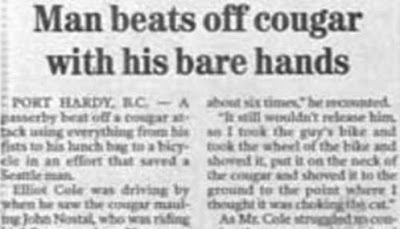
If you're anything like me, that's too bad. You must be a disappointment to your parents. Anyway, I happen to love funny newspaper headlines. The humor is juvenile and infantile but they make me laugh and laughter is sort of like medicine. If you're looking for a dose, open your mouth and pinch your nose.


20.7.10

Everybody wants to rule the world...

The Top 100 Things I'd Do
If I Ever Became An Evil Overlord

  1. My Legions of Terror will have helmets with clear plexiglass visors, not face-concealing ones.

  2. My ventilation ducts will be too small to crawl through.

  3. My noble half-brother whose throne I usurped will be killed, not kept anonymously imprisoned in a forgotten cell of my dungeon.

  4. Shooting is not too good for my enemies.

  5. The artifact which is the source of my power will not be kept on the Mountain of Despair beyond the River of Fire guarded by the Dragons of Eternity. It will be in my safe-deposit box. The same applies to the object which is my one weakness.

  6. I will not gloat over my enemies' predicament before killing them.

  7. When I've captured my adversary and he says, "Look, before you kill me, will you at least tell me what this is all about?" I'll say, "No." and shoot him. No, on second thought I'll shoot him then say "No."

  8. After I kidnap the beautiful princess, we will be married immediately in a quiet civil ceremony, not a lavish spectacle in three weeks' time during which the final phase of my plan will be carried out.

  9. I will not include a self-destruct mechanism unless absolutely necessary. If it is necessary, it will not be a large red button labelled "Danger: Do Not Push". The big red button marked "Do Not Push" will instead trigger a spray of bullets on anyone stupid enough to disregard it. Similarly, the ON/OFF switch will not clearly be labelled as such.

  10. I will not interrogate my enemies in the inner sanctum -- a small hotel well outside my borders will work just as well.

  11. I will be secure in my superiority. Therefore, I will feel no need to prove it by leaving clues in the form of riddles or leaving my weaker enemies alive to show they pose no threat.

  12. One of my advisors will be an average five-year-old child. Any flaws in my plan that he is able to spot will be corrected before implementation.

  13. All slain enemies will be cremated, or at least have several rounds of ammunition emptied into them, not left for dead at the bottom of the cliff. The announcement of their deaths, as well as any accompanying celebration, will be deferred until after the aforementioned disposal.

  14. The hero is not entitled to a last kiss, a last cigarette, or any other form of last request.

  15. I will never employ any device with a digital countdown. If I find that such a device is absolutely unavoidable, I will set it to activate when the counter reaches 117 and the hero is just putting his plan into operation.

  16. I will never utter the sentence "But before I kill you, there's just one thing I want to know."

  17. When I employ people as advisors, I will occasionally listen to their advice.

  18. I will not have a son. Although his laughably under-planned attempt to usurp power would easily fail, it would provide a fatal distraction at a crucial point in time.

  19. I will not have a daughter. She would be as beautiful as she was evil, but one look at the hero's rugged countenance and she'd betray her own father.

  20. Despite its proven stress-relieving effect, I will not indulge in maniacal laughter. When so occupied, it's too easy to miss unexpected developments that a more attentive individual could adjust to accordingly.

  21. I will hire a talented fashion designer to create original uniforms for my Legions of Terror, as opposed to some cheap knock-offs that make them look like Nazi stormtroopers, Roman footsoldiers, or savage Mongol hordes. All were eventually defeated and I want my troops to have a more positive mind-set.

  22. No matter how tempted I am with the prospect of unlimited power, I will not consume any energy field bigger than my head.

  23. I will keep a special cache of low-tech weapons and train my troops in their use. That way -- even if the heroes manage to neutralize my power generator and/or render the standard-issue energy weapons useless -- my troops will not be overrun by a handful of savages armed with spears and rocks.

  24. I will maintain a realistic assessment of my strengths and weaknesses. Even though this takes some of the fun out of the job, at least I will never utter the line "No, this cannot be! I AM INVINCIBLE!!!" (After that, death is usually instantaneous.)

  25. No matter how well it would perform, I will never construct any sort of machinery which is completely indestructible except for one small and virtually inaccessible vulnerable spot.

  26. No matter how attractive certain members of the rebellion are, there is probably someone just as attractive who is not desperate to kill me. Therefore, I will think twice before ordering a prisoner sent to my bedchamber.

  27. I will never build only one of anything important. All important systems will have redundant control panels and power supplies. For the same reason I will always carry at least two fully loaded weapons at all times.

  28. My pet monster will be kept in a secure cage from which it cannot escape and into which I could not accidentally stumble.

  29. I will dress in bright and cheery colors, and so throw my enemies into confusion.

  30. All bumbling conjurers, clumsy squires, no-talent bards, and cowardly thieves in the land will be preemptively put to death. My foes will surely give up and abandon their quest if they have no source of comic relief.

  31. All naive, busty tavern wenches in my realm will be replaced with surly, world-weary waitresses who will provide no unexpected reinforcement and/or romantic subplot for the hero or his sidekick.

  32. I will not fly into a rage and kill a messenger who brings me bad news just to illustrate how evil I really am. Good messengers are hard to come by.

  33. I won't require high-ranking female members of my organization to wear a stainless-steel bustier. Morale is better with a more casual dress-code. Similarly, outfits made entirely from black leather will be reserved for formal occasions.

  34. I will not turn into a snake. It never helps.

  35. I will not grow a goatee. In the old days they made you look diabolic. Now they just make you look like a disaffected member of Generation X.

  36. I will not imprison members of the same party in the same cell block, let alone the same cell. If they are important prisoners, I will keep the only key to the cell door on my person instead of handing out copies to every bottom-rung guard in the prison.

  37. If my trusted lieutenant tells me my Legions of Terror are losing a battle, I will believe him. After all, he's my trusted lieutenant.

  38. If an enemy I have just killed has a younger sibling or offspring anywhere, I will find them and have them killed immediately, instead of waiting for them to grow up harboring feelings of vengeance towards me in my old age.

  39. If I absolutely must ride into battle, I will certainly not ride at the forefront of my Legions of Terror, nor will I seek out my opposite number among his army.

  40. I will be neither chivalrous nor sporting. If I have an unstoppable superweapon, I will use it as early and as often as possible instead of keeping it in reserve.

  41. Once my power is secure, I will destroy all those pesky time-travel devices.

  42. When I capture the hero, I will make sure I also get his dog, monkey, ferret, or whatever sickeningly cute little animal capable of untying ropes and filching keys happens to follow him around.

  43. I will maintain a healthy amount of skepticism when I capture the beautiful rebel and she claims she is attracted to my power and good looks and will gladly betray her companions if I just let her in on my plans.

  44. I will only employ bounty hunters who work for money. Those who work for the pleasure of the hunt tend to do dumb things like even the odds to give the other guy a sporting chance.

  45. I will make sure I have a clear understanding of who is responsible for what in my organization. For example, if my general screws up I will not draw my weapon, point it at him, say "And here is the price for failure," then suddenly turn and kill some random underling.

  46. If an advisor says to me "My liege, he is but one man. What can one man possibly do?", I will reply "This." and kill the advisor.

  47. If I learn that a callow youth has begun a quest to destroy me, I will slay him while he is still a callow youth instead of waiting for him to mature.

  48. I will treat any beast which I control through magic or technology with respect and kindness. Thus if the control is ever broken, it will not immediately come after me for revenge.

  49. If I learn the whereabouts of the one artifact which can destroy me, I will not send all my troops out to seize it. Instead I will send them out to seize something else and quietly put a Want-Ad in the local paper.

  50. My main computers will have their own special operating system that will be completely incompatible with standard IBM and Macintosh powerbooks.

  51. If one of my dungeon guards begins expressing concern over the conditions in the beautiful princess' cell, I will immediately transfer him to a less people-oriented position.

  52. I will hire a team of board-certified architects and surveyors to examine my castle and inform me of any secret passages and abandoned tunnels that I might not know about.

  53. If the beautiful princess that I capture says "I'll never marry you! Never, do you hear me, NEVER!!!", I will say "Oh well" and kill her.

  54. I will not strike a bargain with a demonic being then attempt to double-cross it simply because I feel like being contrary.

  55. The deformed mutants and odd-ball psychotics will have their place in my Legions of Terror. However before I send them out on important covert missions that require tact and subtlety, I will first see if there is anyone else equally qualified who would attract less attention.

  56. My Legions of Terror will be trained in basic marksmanship. Any who cannot learn to hit a man-sized target at 10 meters will be used for target practice.

  57. Before employing any captured artifacts or machinery, I will carefully read the owner's manual.

  58. If it becomes necessary to escape, I will never stop to pose dramatically and toss off a one-liner.

  59. I will never build a sentient computer smarter than I am.

  60. My five-year-old child advisor will also be asked to decipher any code I am thinking of using. If he breaks the code in under 30 seconds, it will not be used. Note: this also applies to passwords.

  61. If my advisors ask "Why are you risking everything on such a mad scheme?", I will not proceed until I have a response that satisfies them.

  62. I will design fortress hallways with no alcoves or protruding structural supports which intruders could use for cover in a firefight.

  63. Bulk trash will be disposed of in incinerators, not compactors. And they will be kept hot, with none of that nonsense about flames going through accessible tunnels at predictable intervals.

  64. I will see a competent psychiatrist and get cured of all extremely unusual phobias and bizarre compulsive habits which could prove to be a disadvantage.

  65. If I must have computer systems with publically available terminals, the maps they display of my complex will have a room clearly marked as the Main Control Room. That room will be the Execution Chamber. The actual main control room will be marked as Sewage Overflow Containment.

  66. My security keypad will actually be a fingerprint scanner. Anyone who watches someone press a sequence of buttons or dusts the pad for fingerprints then subsequently tries to enter by repeating that sequence will trigger the alarm system.

  67. No matter how many shorts we have in the system, my guards will be instructed to treat every surveillance camera malfunction as a full-scale emergency.

  68. I will spare someone who saved my life sometime in the past. This is only reasonable as it encourages others to do so. However, the offer is good one time only. If they want me to spare them again, they'd better save my life again.

  69. All midwives will be banned from the realm. All babies will be delivered at state-approved hospitals. Orphans will be placed in foster-homes, not abandoned in the woods to be raised by creatures of the wild.

  70. When my guards split up to search for intruders, they will always travel in groups of at least two. They will be trained so that if one of them disappears mysteriously while on patrol, the other will immediately initiate an alert and call for backup, instead of quizzically peering around a corner.

  71. If I decide to test a lieutenant's loyalty and see if he/she should be made a trusted lieutenant, I will have a crack squad of marksmen standing by in case the answer is no.

  72. If all the heroes are standing together around a strange device and begin to taunt me, I will pull out a conventional weapon instead of using my unstoppable superweapon on them.

  73. I will not agree to let the heroes go free if they win a rigged contest, even though my advisors assure me it is impossible for them to win.

  74. When I create a multimedia presentation of my plan designed so that my five-year-old advisor can easily understand the details, I will not label the disk "Project Overlord" and leave it lying on top of my desk.

  75. I will instruct my Legions of Terror to attack the hero en masse, instead of standing around waiting while members break off and attack one or two at a time.

  76. If the hero runs up to my roof, I will not run up after him and struggle with him in an attempt to push him over the edge. I will also not engage him at the edge of a cliff. (In the middle of a rope-bridge over a river of molten lava is not even worth considering.)

  77. If I have a fit of temporary insanity and decide to give the hero the chance to reject a job as my trusted lieutentant, I will retain enough sanity to wait until my current trusted lieutenant is out of earshot before making the offer.

  78. I will not tell my Legions of Terror "And he must be taken alive!" The command will be "And try to take him alive if it is reasonably practical."

  79. If my doomsday device happens to come with a reverse switch, as soon as it has been employed it will be melted down and made into limited-edition commemorative coins.

  80. If my weakest troops fail to eliminate a hero, I will send out my best troops instead of wasting time with progressively stronger ones as he gets closer and closer to my fortress.

  81. If I am fighting with the hero atop a moving platform, have disarmed him, and am about to finish him off and he glances behind me and drops flat, I too will drop flat instead of quizzically turning around to find out what he saw.

  82. I will not shoot at any of my enemies if they are standing in front of the crucial support beam to a heavy, dangerous, unbalanced structure.

  83. If I'm eating dinner with the hero, put poison in his goblet, then have to leave the table for any reason, I will order new drinks for both of us instead of trying to decide whether or not to switch with him.

  84. I will not have captives of one sex guarded by members of the opposite sex.

  85. I will not use any plan in which the final step is horribly complicated, e.g. "Align the 12 Stones of Power on the sacred altar then activate the medallion at the moment of total eclipse." Instead it will be more along the lines of "Push the button."

  86. I will make sure that my doomsday device is up to code and properly grounded.

  87. My vats of hazardous chemicals will be covered when not in use. Also, I will not construct walkways above them.

  88. If a group of henchmen fail miserably at a task, I will not berate them for incompetence then send the same group out to try the task again.

  89. After I captures the hero's superweapon, I will not immediately disband my legions and relax my guard because I believe whoever holds the weapon is unstoppable. After all, the hero held the weapon and I took it from him.

  90. I will not design my Main Control Room so that every workstation is facing away from the door.

  91. I will not ignore the messenger that stumbles in exhausted and obviously agitated until my personal grooming or current entertainment is finished. It might actually be important.

  92. If I ever talk to the hero on the phone, I will not taunt him. Instead I will say this his dogged perseverance has given me new insight on the futility of my evil ways and that if he leaves me alone for a few months of quiet contemplation I will likely return to the path of righteousness. (Heroes are incredibly gullible in this regard.)

  93. If I decide to hold a double execution of the hero and an underling who failed or betrayed me, I will see to it that the hero is scheduled to go first.

  94. When arresting prisoners, my guards will not allow them to stop and grab a useless trinket of purely sentimental value.

  95. My dungeon will have its own qualified medical staff complete with bodyguards. That way if a prisoner becomes sick and his cellmate tells the guard it's an emergency, the guard will fetch a trauma team instead of opening up the cell for a look.

  96. My door mechanisms will be designed so that blasting the control panel on the outside seals the door and blasting the control panel on the inside opens the door, not vice versa.

  97. My dungeon cells will not be furnished with objects that contain reflective surfaces or anything that can be unravelled.

  98. If an attractive young couple enters my realm, I will carefully monitor their activities. If I find they are happy and affectionate, I will ignore them. However if circumstance have forced them together against their will and they spend all their time bickering and criticizing each other except during the intermittent occasions when they are saving each others' lives at which point there are hints of sexual tension, I will immediately order their execution.

  99. Any data file of crucial importance will be padded to 1.45Mb in size.

  100. Finally, to keep my subjects permanently locked in a mindless trance, I will provide each of them with free unlimited Internet access.
This was passed along to me on the Interwebs so I can't give credit to the clever duck who composed it.

25.5.10

Lost finale explained by one of the show's writers


First ...
The Island:

It was real. Everything that happened on the island that we saw throughout the 6 seasons was real. Forget the final image of the plane crash, it was put in purposely to f*&k with people's heads and show how far the show had come. They really crashed. They really survived. They really discovered Dharma and the Others. The Island keeps the balance of good and evil in the world. It always has and always will perform that role. And the Island will always need a "Protector". Jacob wasn't the first, Hurley won't be the last. However, Jacob had to deal with a malevolent force (MIB) that his mother, nor Hurley had to deal with. He created the devil and had to find a way to kill him -- even though the rules prevented him from actually doing so.

Thus began Jacob's plan to bring candidates to the Island to do the one thing he couldn't do. Kill the MIB. He had a huge list of candidates that spanned generations. Yet everytime he brought people there, the MIB corrupted them and caused them to kill one another. That was until Richard came along and helped Jacob understand that if he didn't take a more active role, then his plan would never work.

Enter Dharma -- which I'm not sure why John is having such a hard time grasping. Dharma, like the countless scores of people that were brought to the island before, were brought there by Jacob as part of his plan to kill the MIB. However, the MIB was aware of this plan and interferred by "corrupting" Ben. Making Ben believe he was doing the work of Jacob when in reality he was doing the work of the MIB. This carried over into all of Ben's "off-island" activities. He was the leader. He spoke for Jacob as far as they were concerned. So the "Others" killed Dharma and later were actively trying to kill Jack, Kate, Sawyer, Hurley and all the candidates because that's what the MIB wanted. And what he couldn't do for himself.

Dharma was originally brought in to be good. But was turned bad by MIB's corruption and eventually destroyed by his pawn Ben. Now, was Dharma only brought there to help Jack and the other Canditates on their overall quest to kill Smokey? Or did Jacob have another list of Canidates from the Dharma group that we were never aware of? That's a question that is purposley not answered because whatever answer the writers came up with would be worse than the one you come up with for yourself. Still ... Dharma's purpose is not "pointless" or even vague. Hell, it's pretty blantent.

Still, despite his grand plan, Jacob wanted to give his "candidates" (our Lostaways) the one thing he, nor his brother, were ever afforded: free will. Hence him bringing a host of "candidates" through the decades and letting them "choose" which one would actually do the job in the end. Maybe he knew Jack would be the one to kill Flocke and that Hurley would be the protector in the end. Maybe he didn't. But that was always the key question of the show: Fate vs Free-will. Science vs Faith. Personally I think Jacob knew from the beginning what was going to happen and that everyone played a part over 6 seasons in helping Jack get to the point where he needed to be to kill Smokey and make Hurley the protector -- I know that's how a lot of the writers viewed it. But again, they won't answer that (nor should they) because that ruins the fun.

In the end, Jack got to do what he always wanted to do from the very first episode of the show: Save his fellow Lostaways. He got Kate and Sawyer off the island and he gave Hurley the purpose in life he'd always been missing. And, in Sideways world (which we'll get to next) he in fact saved everyone by helping them all move on ...

Now...

Sideways World:

Sideways world is where it gets really cool in terms of theology and metaphysical discussion (for me at least -- because I love history/religion theories and loved all the talks in the writer's room about it). Basically what the show is proposing is that we're all linked to certain people during our lives. Call them soulmates (though it's not exactly the best word). But these people we're linked to are with us duing "the most important moments of our lives" as Christian said. These are the people we move through the universe with from lifetime to lifetime. It's loosely based in Hinduisim with large doses of western religion thrown into the mix.

The conceit that the writers created, basing it off these religious philosophies, was that as a group, the Lostaways subconsciously created this "sideways" world where they exist in purgatory until they are "awakened" and find one another. Once they all find one another, they can then move on and move forward. In essence, this is the show's concept of the afterlife. According to the show, everyone creates their own "Sideways" purgatory with their "soulmates" throughout their lives and exist there until they all move on together. That's a beautiful notion. Even if you aren't religious or even spirtual, the idea that we live AND die together is deeply profound and moving.

It's a really cool and spirtual concept that fits the whole tone and subtext the show has had from the beginning. These people were SUPPOSED to be together on that plane. They were supposed to live through these events -- not JUST because of Jacob. But because that's what the universe or God (depending on how religious you wish to get) wanted to happen. The show was always about science vs faith -- and it ultimately came down on the side of faith. It answered THE core question of the series. The one question that has been at the root of every island mystery, every character backstory, every plot twist. That, by itself, is quite an accomplishment.

How much you want to extrapolate from that is up to you as the viewer. Think about season 1 when we first found the Hatch. Everyone thought that's THE answer! Whatever is down there is the answer! Then, as we discovered it was just one station of many. One link in a very long chain that kept revealing more, and more of a larger mosiac.

But the writer's took it even further this season by contrasting this Sideways "purgatory" with the Island itself. Remember when Michael appeared to Hurley, he said he was not allowed to leave the Island. Just like the MIB. He wasn't allowed into this sideways world and thus, was not afforded the opportunity to move on. Why? Because he had proven himself to be unworthy with his actions on the Island. He failed the test. The others, passed. They made it into Sideways world when they died -- some before Jack, some years later. In Hurley's case, maybe centuries later. They exist in this sideways world until they are "awakened" and they can only move on TOGETHER because they are linked. They are destined to be together for eternity. That was their destiny.

They were NOT linked to Anna Lucia, Daniel, Roussou, Alex, Miles, Lupidis, (and all the rest who weren't in the chuch -- basically everyone who wasn't in season 1). Yet those people exist in Sideways world. Why? Well again, here's where they leave it up to you to decide. The way I like to think about it, is that those people who were left behind in Sideways world have to find their own soulmates before they can wake up. It's possible that those links aren't people from the island but from their other life (Anna's parnter, the guy she shot --- Roussou's husband, etc etc).

A lot of people have been talking about Ben and why he didn't go into the Church. And if you think of Sideways world in this way, then it gives you the answer to that very question. Ben can't move on yet because he hasn't connected with the people he needs to. It's going to be his job to awaken Roussou, Alex, Anna Lucia (maybe), Ethan, Goodspeed, his father and the rest. He has to attone for his sins more than he did by being Hurley's number two. He has to do what Hurley and Desmond did for our Lostaways with his own people. He has to help them connect. And he can only move on when all the links in his chain are ready to. Same can be said for Faraday, Charlotte, Whidmore, Hawkins etc. It's really a neat, and cool concept. At least to me.

But, from a more "behind the scenes" note: the reason Ben's not in the church, and the reason no one is in the church but for Season 1 people is because they wrote the ending to the show after writing the pilot. And never changed it. The writers always said (and many didn't believe them) that they knew their ending from the very first episode. I applaud them for that. It's pretty fantastic. Originally Ben was supposed to have a 3 episode arc and be done. But he became a big part of the show. They could have easily changed their ending and put him in the church -- but instead they problem solved it. Gave him a BRILLIANT moment with Locke outside the church ... and then that was it. I loved that. For those that wonder -- the original ending started the moment Jack walked into the church and touches the casket to Jack closing his eyes as the other plane flies away. That was always JJ's ending. And they kept it.

For me the ending of this show means a lot. Not only because I worked on it, but because as a writer it inspired me in a way the medium had never done before. I've been inspired to write by great films. Maybe too many to count. And there have been amazing TV shows that I've loved (X-Files, 24, Sopranos, countless 1/2 hour shows). But none did what LOST did for me. None showed me that you could take huge risks (writing a show about faith for network TV) and stick to your creative guns and STILL please the audience. I learned a lot from the show as a writer. I learned even more from being around the incredible writers, producers, PAs, interns and everyone else who slaved on the show for 6 years.

In the end, for me, LOST was a touchstone show that dealt with faith, the afterlife, and all these big, spirtual questions that most shows don't touch. And to me, they never once waivered from their core story -- even with all the sci-fi elements they mixed in. To walk that long and daunting of a creative tightrope and survive is simply astounding.

12.5.10

Long time no blog...


I've got a hundred reasons why I've all but stopped my blogging, but I don't want to list them and you probably don't want to read them.

Mostly I've been writing a couple of new young adult novels, doing some paying work, and spending way too much time on Facebook.

Facebook has allowed me to get back in touch with people I haven't seen in 25-30 years, to make a bunch of new friends with similar interests and skewed views of the world, and to be in steady contact with my regular stable of chums.

I imagine I'll return to blogging eventually. It's too much fun to put away forever.

Until then, you'll know where to reach me.

23.12.09

The Little Drummer Boy as told by Fred Schiller


Sleepy Newborn Baby + Drum Solo = Disaster

(Written in the Mad Magazine spirit of Jack Davis, Don Martin and Mort Drucker.)

We open with a wide shot of the desert at night that shows a long line of people waiting to get into THE MANGER. Huge billboards (like the kind you see on the freeway—Wisconsin Dells This Way—You’re Almost at Garlic City—Only Ten More Miles To The Biggest Ball Of Twine In Alabama) announce THIS WAY TO SEE THE NEWBORN KING and YOU’RE ALMOST AT THE BABY JESUS and PLEASE FORM A SINGLE LINE TO SEE BABY JESUS. Walking up and down the line of people are vendors with carts selling FRIED YAK ON A STICK and CUP O’HUMMUS and FAR-FROM-AWFUL-FALAFEL.

Standing in the middle of the line is the LITTLE DRUMMER BOY. For some reason I picture him as a 60’s kind of British punk, with a shaggy haircut covering his eyes and a punkish stance. He’s got a snare drum balanced on his hip, hanging from a strap around his shoulder. He twirls drumsticks in both hands and looks bored. He stops twirling when he sees a sign that says PLEASE HAVE GIFTS FOR THE NEWBORN KING READY UPON ENTERING MANGER. He taps the guy in line in front of him on the shoulder with a drumstick and asks, “Oh, man! We were supposed to bring a present?” The guy he’s talking to is one of the Three Wise Men. He’s kind of a stoner. He’s the one bringing frankincense and it looks like he’s been smoking some of it while he waits. “If you know what’s good for you, you’d better bring something. The child is our new king!”

The Drummer Boy sort of recites a line from the song. “I have no gifts to bring. I’m but a poor dude too!” He thinks for a moment then he snaps his fingers and declares that he’ll just play the little baby a wicked drum solo. The kid ought to like that.

The Wise Man shakes his head and points to the very front of the line where see the LITTLE TRUMPET BOY is blasting out a trumpet solo for the baby Jesus. The baby screams so loud the Trumpet Boy’s face looks like he’s pulling ten G’s in a centrifuge. Then a dozen lightning bolts hit the Trumpet Boy, leaving only a smoking cinder of a skeleton standing there. When the smoke clears, the next guy in line, who is visibly jittery, gives his present to the baby. It’s a little kitten, and when the baby coos with joy, the guy wipes a roll of nervous sweat off his face.

Back in the line the Drummer Boy knows his goose is cooked. Or at least it will be when it’s his turn. Everyone else in line seems to have something reasonably good to give. A wooly sheep, a potted plant, baked goods, a cow, homemade toys, and such. Drummer Boy asks the Wise Man to save his spot and he’ll be right back.

We cut to Drummer Boy popping into the Jerusalem version of an AM/PM mini-mart. He scours the shelves for something good to give. There’s a tin of Camel Wax, a robe that has ‘MY PARENTS WENT TO JERUSALEM AND ALL I GOT WAS THIS CRUMMY ROBE’ lettered on it, a rack of crude baseball caps and sun visors (woven out of palm fronds), yak jerky, chunks of flint with novelty sayings on them, and stuff like that.

Then he sees it. The perfect gift. It sits on a shelf, in a glowing angelic halo of light. It’s a can of MYRRH (it’s about the size of a gallon of paint). Slogans on the can read NEWBORN BABIES LOVE IT! and IT’S THE INCENSE THAT CHOOSY VIRGIN MOTHERS CHOOSE.

We see the Drummer Boy reach for the myrrh, but at the same time another guy reaches for it. Each have a hand on it and a tugging match ensues. (The guy that Drummer Boy is fighting with should be dressed in the same sort of fancy robes as the Wise Man he was in line behind earlier. It turns out that he’s Wise Man #2)

Push comes to shove and fists are thrown, but then the Wise Man holds up his hands to call a truce. He reminds the Drummer Boy that this day isn’t about the two of them, it’s a day to celebrate the newborn king. Today is the day of all days to put petty differences aside.

While the Drummer Boy is pondering these profound words, the Wise Man grabs the can of myrrh and races off with it. The Drummer Boy chases after in hot pursuit.

We cut to later that night, back at the manger, where we see Mary and Joseph examining yet another gift that has been given. It’s a scuffed up and slightly dented can of myrrh. The note attached to the can reads, HAPPY BIRTHDAY, NEWBORN KING and signed below are the names LITTLE DRUMMER BOY and WISE MAN #2. Mary and Joseph look up and see Drummer Boy and Wise Man #2 standing there, arms around each other, with torn robes, missing teeth, a couple of black eyes, bandaged limbs, and maybe a crude pair of crutches made out of a tree branch. They’ve been through hell but they still smile at the little fellow they see down in the manger.

THE END